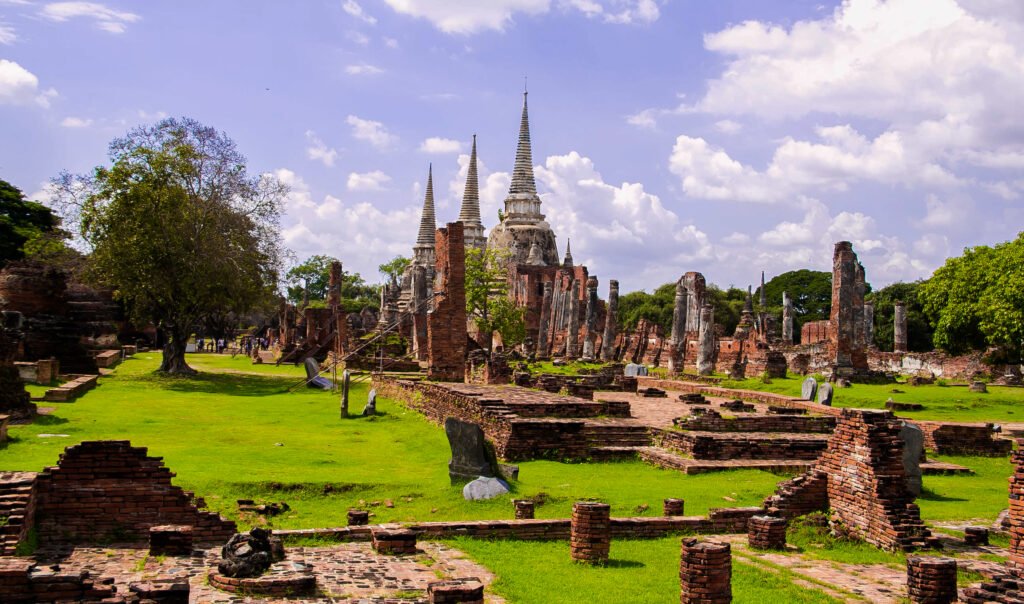
A surreal sight greets every visitor who steps onto the grounds of Wat Mahathat: rows of headless Buddha statues sit in silence, guarding the collapsed central prang (tower). The structure, built in the distinct Khmer style, is broken, yet it still reaches skyward like a defiant fist.
These ruins are not merely old temples aging gracefully; they are the physical remains of one of Southeast Asia’s greatest cosmopolitan empires. Here, 14th-century architects deliberately repurposed Khmer architectural forms to serve Theravada Buddhist ideology during a period of explosive urban growth. This grandeur lasted until 1767, when Burmese armies systematically reduced the capital to ashes, executing one of the most devastating sacks in pre-modern history.
Let’s look at the history of this fascinating place.
The Strategic Location and 14th-Century Ascendancy of Ayutthaya
To understand why Ayutthaya became a powerhouse, we must look at the water. The kingdom’s dominance was not a fluke of history but a result of precise geographic selection.
Founding and Geographic Advantage
When King U Thong founded Ayutthaya in 1351, he chose the site with a strategist’s eye. He positioned his new capital at the confluence of three major rivers: the Chao Phraya, the Lopburi, and the Pa Sak. This hydrology effectively turned the city into an island, providing a natural defense system that made invasions difficult.
Beyond defense, this location served as an economic engine. The surrounding floodplain was perfect for wet-rice agriculture, ensuring the city could feed a massive population. Simultaneously, the river network connected the capital to the sea, facilitating international trade. By the late 14th century, this combination of food security and commerce transformed Ayutthaya into one of the world’s largest cities. Historical estimates place the population between 300,000 and 400,000 people—a scale that surpassed contemporary global centers like Paris or Nanjing.
Urban Expansion and Royal Temple-Building Campaign (1370s–1420s)
With wealth flowing from the rivers, the city underwent a massive physical transformation. Between the 1370s and 1420s, Kings Borommaracha I, Ramesuan, and Intharacha channeled resources into a grand urban expansion. They dug new moats to expand the hydraulic grid, erected sturdy brick walls to replace earthen ramparts, and significantly expanded the palace precincts.
The most visible sign of this new power, however, was the construction of monumental monasteries. In a fascinating cultural pivot, these kings consciously adopted the Khmer prang form. Previously, this architectural style was associated with the fallen Angkor Empire. Ayutthaya’s rulers appropriated this visual language, turning the ultimate symbol of Khmer power into the centerpiece of their new Theravada state.
Wat Mahathat and the Khmer Prang as Theravada Icon
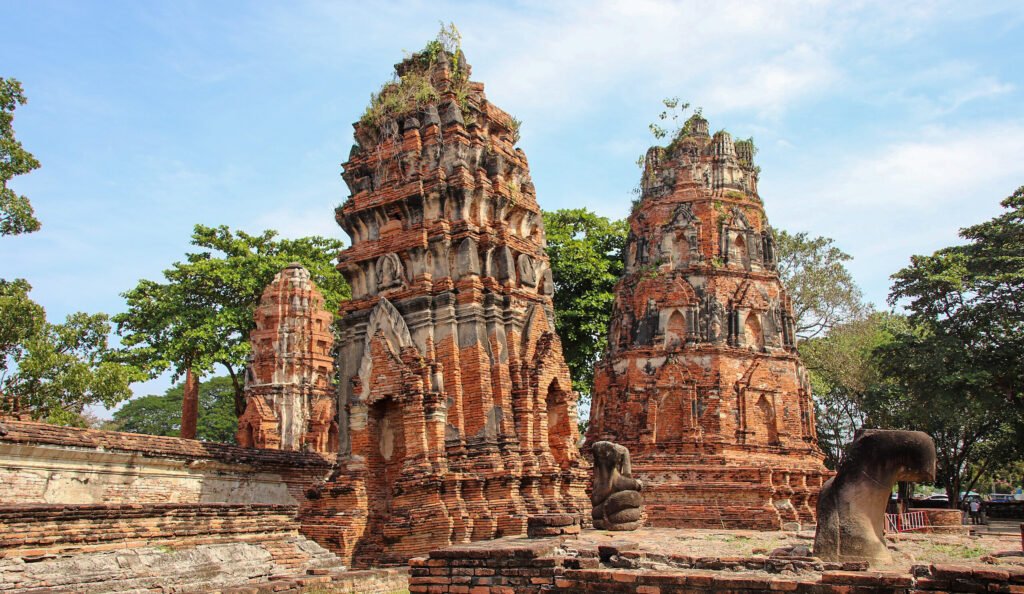
The result of this architectural appropriation is best viewed at Wat Mahathat, the spiritual center of the early capital.
Architectural Features and Khmer Inheritance
In its original late-14th-century layout, Wat Mahathat was an imposing display of verticality. A towering central prang, estimated to have stood approximately 46 meters (150 feet) high, anchored the complex on a raised platform. Four corner prangs and smaller subsidiary towers flanked this central spire.
The builders utilized the distinctive Khmer “corn-cob” style. They constructed the cores using laterite—a porous, reddish clay-stone accessible locally—and covered the surfaces with intricate stucco decoration. These designs included deliberate stylistic quotes from the great temples of Angkor Wat and the Lopburi era. However, the architects did not simply copy; they scaled and arranged these elements to fit Sukhothai-Ayutthaya preferences, creating a thinner, more tapered profile than their Cambodian predecessors.
Symbolic Transformation: From Hindu-Mahayana to Theravada Cosmology
The physical structure tells only half the story; the ideological shift is where the true genius of Ayutthaya’s kings lies. At Angkor, the prang functioned as a Hindu shrine housing a linga (a symbol of Shiva) or a Mahayana reliquary tower. Ayutthaya’s theologians and architects reinterpreted this form completely.
In this new context, the prang became the architectural representation of Mount Meru, the sacred mountain at the center of the universe in Buddhist cosmology. Instead of Hindu deities, these towers housed sacred Buddha relics or images. This move completed the kingdom’s ideological break from Khmer Mahayana and Hindu traditions while retaining their most impressive visual vocabulary. By building these Mount Meru representations, the 14th-century kings legitimized their status as chakravartin—universal monarchs—operating strictly within a Theravada framework.
Today, one specific artifact captures this blend of sanctity and ruin: the famous Buddha head enveloped in banyan roots. It serves as a visual metaphor for both destruction and enduring presence. Likely knocked to the ground during the 1767 sacking, the stone head was abandoned rather than looted. Over the centuries, the roots of a Bodhi tree grew around it, lifting and cradling the face in a natural embrace that visitors now line up to see.
The Burmese Conquest of 1767 and the Deliberate Destruction of Ayutthaya
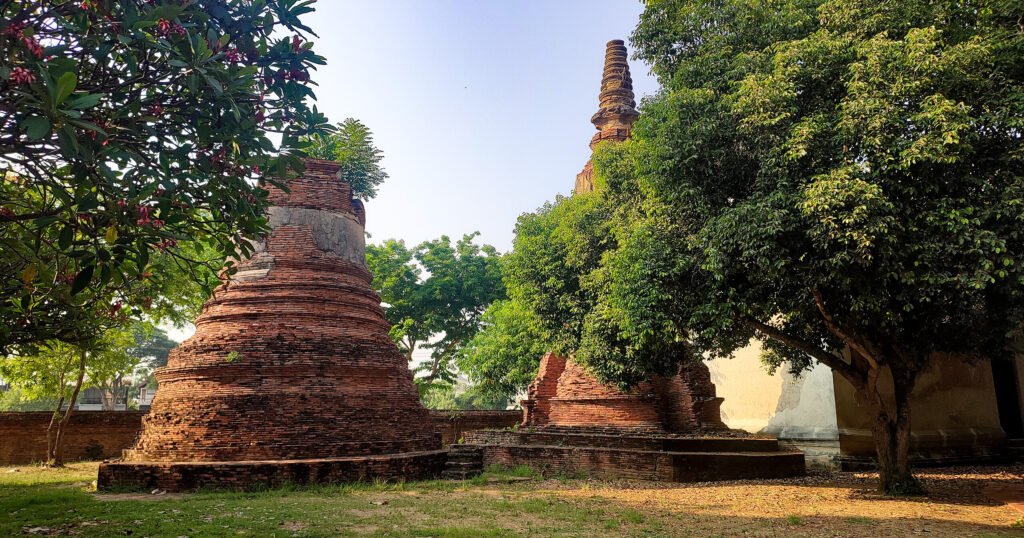
The ruins we walk through today are not the result of gradual decay. They are the crime scene of a systematic execution.
The Final War and the Sack
The end of the empire began with a two-pronged invasion launched by the Burmese King Hsinbyushin. From 1765 to 1767, Burmese forces squeezed the capital, culminating in a brutal 14-month siege. The city’s island defenses, once its greatest asset, became a cage. Starvation weakened the defenders until, on April 7, 1767, the walls were breached.
The subsequent sack was thorough and intentional. The invaders did not just want to loot Ayutthaya; they intended to erase it as a political and cultural entity. Soldiers set temples ablaze and melted down thousands of bronze Buddha images to extract the metal for weaponry or currency. They burned the royal libraries, destroying centuries of literature and records, and forcibly marched artisans, poets, and scholars to the Burmese capital of Ava.
Evidence of Destruction at Wat Mahathat
Wat Mahathat suffered particularly heavy damage during this purge. The central prang, the symbol of the king’s cosmic power, was set on fire, weakening its structure until it eventually collapsed. The headless statues lining the cloisters were not victims of gravity; invaders decapitated them to strip the sanctity from the site. The scars visible on the bricks today are direct evidence of 18th-century military policy. Following this devastation, the city lay uninhabited for decades, its grandeur surviving only in the journals of foreign traders and the ruined towers that still dominate the skyline.
Conclusion
A central paradox defines the Ayutthaya Historical Park. The most visibly “Khmer” elements—the towering prangs that kings erected to broadcast their universal sovereignty in the 14th century—became, after the Burmese fires of 1767, the kingdom’s most eloquent eulogy. For the modern traveler, understanding this synthesis of construction and destruction adds profound depth to the visit.
To see the ruins at their most atmospheric, arrive at dawn when the low light turns the exposed brickwork gold. Renting a bicycle allows for easy movement between the widely spaced temples. Visitors should wear modest clothing out of respect for the site’s religious nature and consider hiring a licensed guide to fully explain the nuances of the Khmer-Theravada synthesis.
Further Readings & Resources
- UNESCO World Heritage Centre – Historic City of Ayutthaya: https://whc.unesco.org/en/list/576/
- Oriental Architecture – Wat Maha That, Ayutthaya (detailed photographs and architectural analysis): https://www.orientalarchitecture.com/sid/243/thailand/ayutthaya/wat-maha-that
- Chris Baker & Pasuk Phongpaichit, “A History of Ayutthaya” (Cambridge University Press, 2017) – Chapter 6 offers the most authoritative modern account of the 1767 fall.
You may also like
Leave a Reply