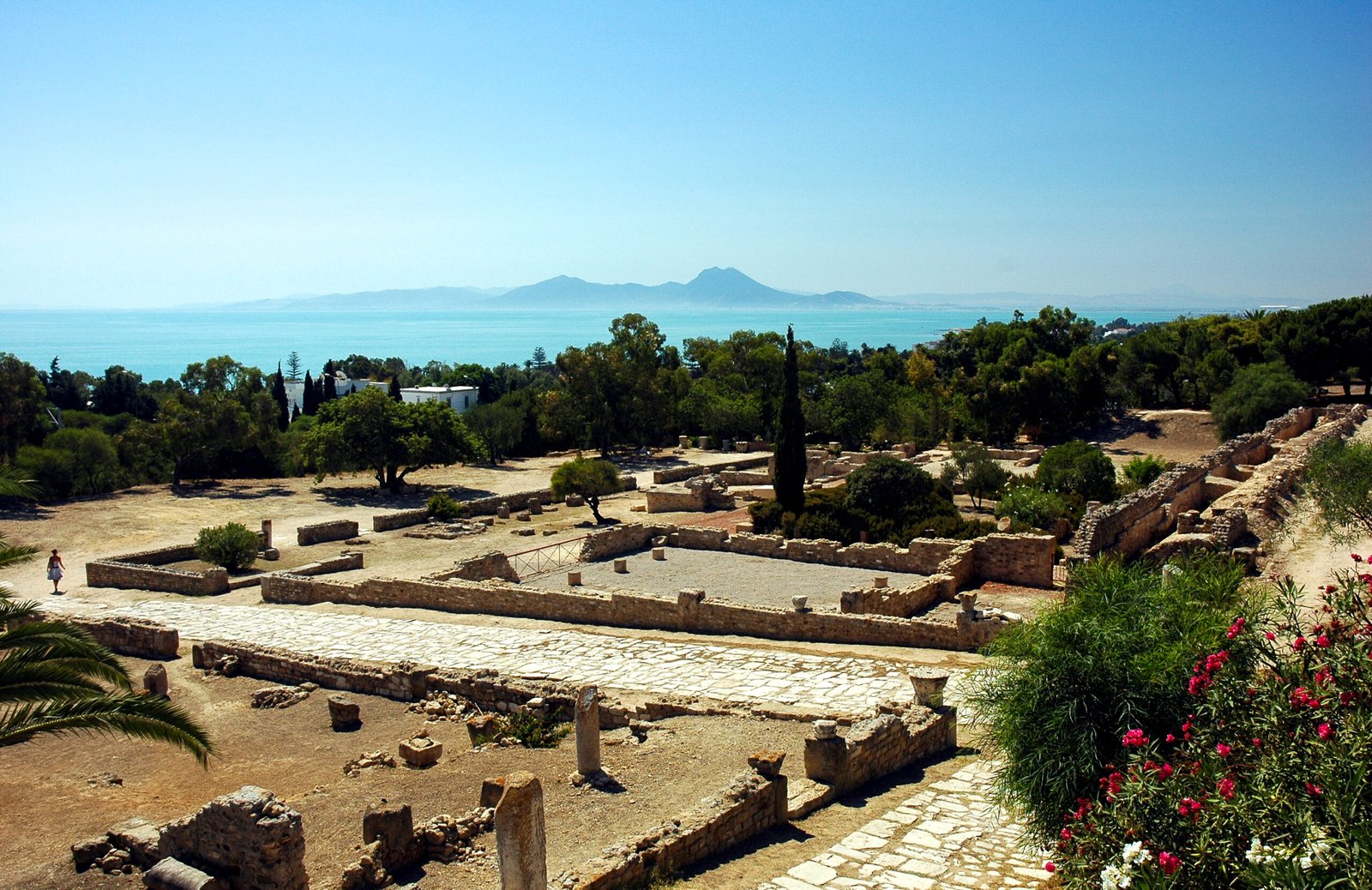
Stroll through the modern, affluent suburb of Carthage on the coast of Tunis, and you’ll find whitewashed villas, lush gardens, and stunning views of a turquoise sea. It’s a tranquil, beautiful corner of the world. But beneath this serene landscape lie the ghosts of not one, but two ancient superpowers. This ground has witnessed the rise of a mighty maritime empire, its complete and brutal annihilation, and its spectacular rebirth as a jewel of its conqueror.
Carthage is not a single ancient city but a place of layers. First came the Phoenician, or Punic, civilization that built a commercial and naval empire powerful enough to challenge the might of Rome. After its destruction, a new Roman city rose from the ashes, grander and more monumental than what came before. For archaeologists and visitors alike, the challenge and fascination lie in uncovering these distinct yet intertwined histories.
In this article, we’ll journey through time to explore the strategic genius of Punic Carthage, the monumental grandeur of Roman Carthage, and how you can trace the faint outlines of both in the landscape of today.
The Geographic Advantage: The Foundation of a Mediterranean Superpower
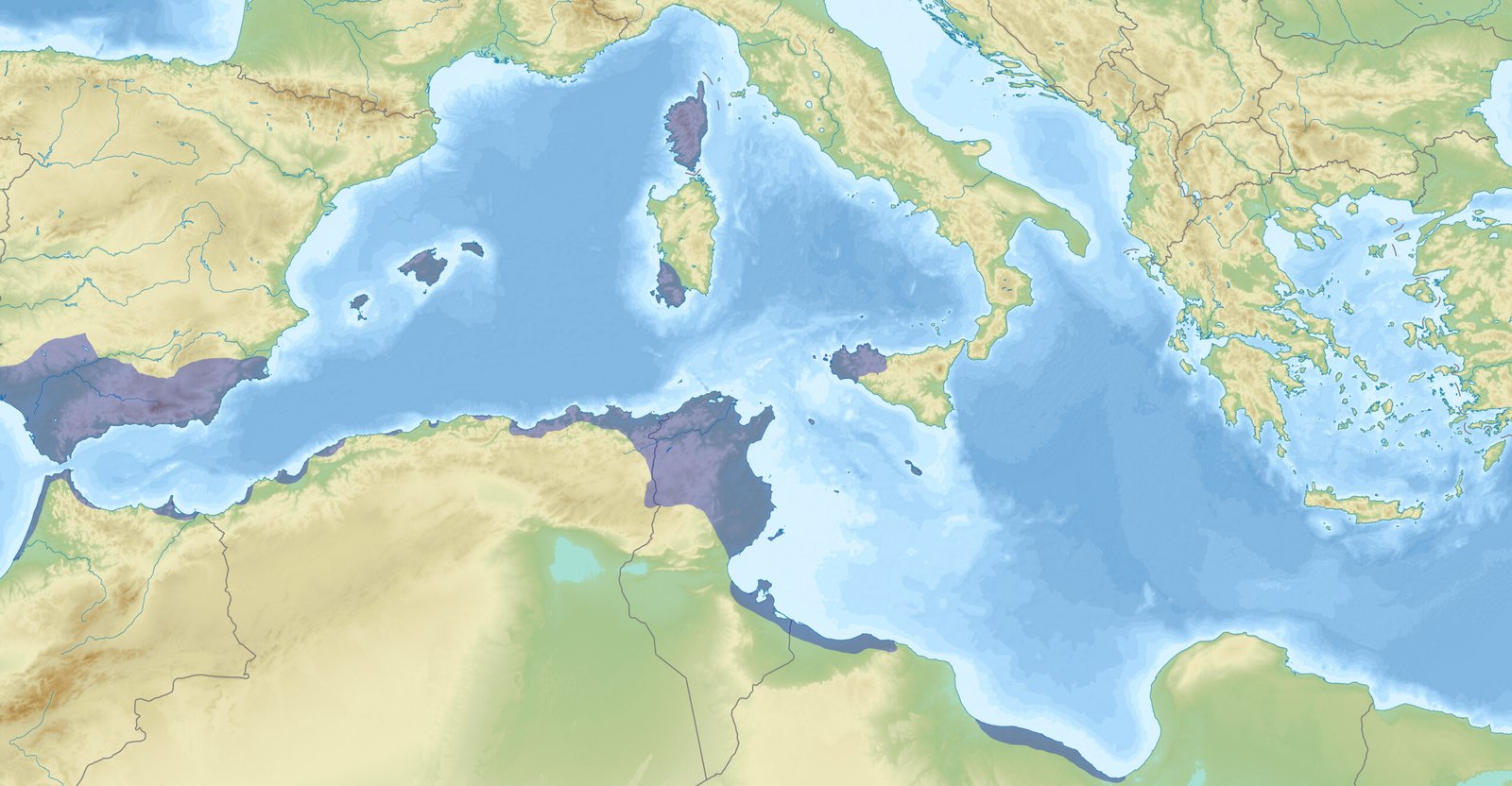
Before we look at the ruins, we first need to appreciate why this specific piece of coastline became the seat of an empire. The story of Carthage’s power begins, as it so often does, with geography.
A Natural Fortress by the Sea
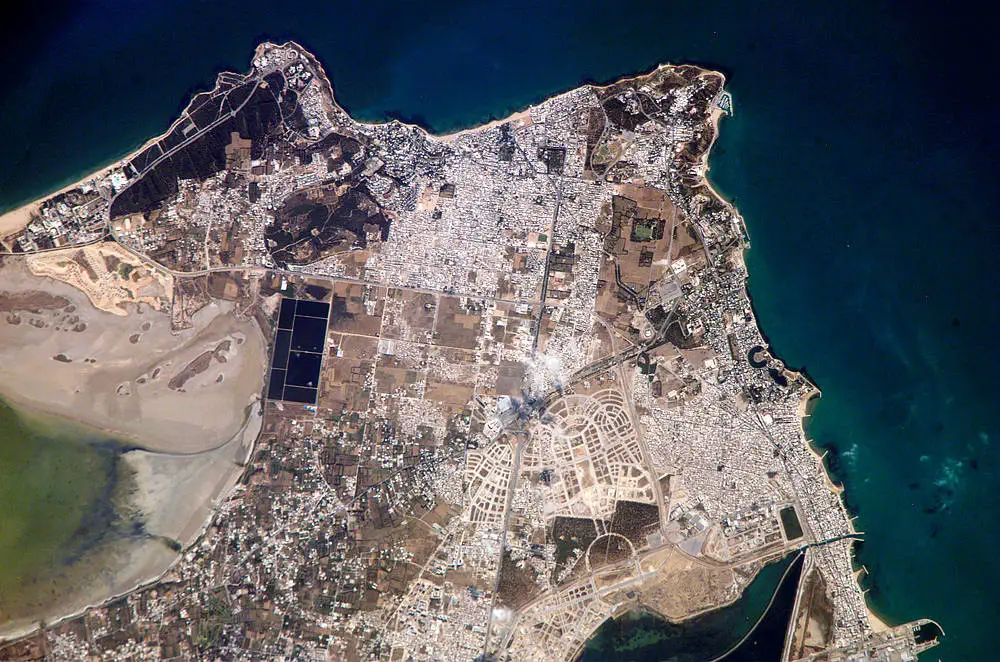
Carthage was founded on a peninsula in the heart of the Gulf of Tunis. This prime piece of real estate was a natural fortress. With the sea on one side and a lake on the other, it was easily defended from land-based attacks. But its true genius was its position in the wider Mediterranean. The city sat at the edge of the narrow Strait of Sicily, the main maritime chokepoint between the eastern and western halves of the sea. From this vantage point, the Carthaginian navy could control the lucrative trade routes connecting Africa, Europe, and the Levant. Any ship wanting to pass had to do so under the watchful eye of Carthage, making it the undisputed gatekeeper of ancient commerce.
The Twin Harbors: The Heart of Punic Naval Power
The engine of this empire was its legendary port complex, a masterpiece of ancient engineering. The design consisted of two interconnected harbors. The first was a large, rectangular commercial port, bustling with merchant ships from across the known world, loading and unloading goods. This was the public face of Carthage’s wealth.
But connected to it by a narrow, defensible channel was a second, secret harbor: a circular military port known as the Cothon. Hidden from the view of visiting ships and spies, this was the heart of Punic naval power. This brilliant design allowed Carthage to maintain a thriving commercial hub while keeping its military might—the true source of its dominance—completely concealed and protected.
From Trading Post to Rome’s Great Rival
Founded by Phoenician colonists around 814 BCE, Carthage grew from a simple trading post into the most powerful maritime force in the western Mediterranean. For centuries, its fleet dominated the seas, establishing colonies in Sicily, Sardinia, and Spain. This expansion inevitably brought it into conflict with another rising power: the Roman Republic. The resulting series of conflicts, known as the Punic Wars, spanned over a century and became a titanic struggle for control of the Mediterranean. It was this existential rivalry that would ultimately seal the city’s fate and set the stage for its eventual, and total, destruction.
The Punic Ghost: Searching for Phoenician Carthage
So, if Punic Carthage was so powerful, where is it today? The answer lies in understanding how thoroughly it was erased, and where archaeologists have managed to find its traces. Searching for Punic Carthage is like searching for a ghost, with only faint echoes remaining beneath the heavy footprint of Rome.
The Cothon: An Engineering Marvel Revealed
The most significant Punic ruin still visible is the Cothon, the circular naval harbor. Today, it’s a calm, circular lagoon, but archaeological investigations have revealed its incredible original form. In the center was an island, topped with a tall structure that gave the admiral a 360-degree view of the harbor and the sea beyond. The perimeter of the harbor was lined with covered dry docks, or ship-sheds, capable of housing an estimated 220 warships. Each ship could be pulled into its own protected bay for repairs and maintenance, safe from the elements and prying eyes. This wasn’t just a port; it was a highly advanced naval base, designed for maximum efficiency and secrecy.
Echoes of Punic Life: The Tophet and Byrsa Hill
Beyond the port, other Punic sites offer glimpses into this lost world. One of the most haunting is the Sanctuary of Tophet, a sacred cemetery containing thousands of urns with the cremated remains of infants. For centuries, historians took the word of Roman and Greek writers who claimed the Carthaginians practiced child sacrifice here, offering their firstborns to the gods in times of crisis. However, some modern scholars challenge this view, arguing that the high infant mortality of the ancient world means this was more likely a special burial ground for stillborns or children who died in infancy. The debate continues, leaving the Tophet a place of profound mystery.
The other key Punic location is Byrsa Hill, the city’s original acropolis. Today, the hill is dominated by the 19th-century Saint Louis Cathedral and the remains of the Roman forum. But dig deeper, and the Punic city emerges. Excavations have uncovered the foundations of a Punic neighborhood, with houses and streets packed tightly together, buried deep beneath the orderly Roman grid that was built directly on top of it.
“Carthage Must Be Destroyed”: Reading History Written by the Victors
The scarcity of Punic remains is no accident. At the end of the Third Punic War in 146 BCE, the Roman general Scipio Aemilianus carried out the Senate’s infamous decree: Carthago delenda est—”Carthage must be destroyed.” The city was sacked, burned for 17 days, and its surviving population sold into slavery. Roman engineers then systematically leveled what was left of the buildings.
There is a famous story that the Romans plowed the land and sowed it with salt to ensure nothing would ever grow there again. While this makes for a powerful image of total annihilation, most modern historians believe it was a 19th-century invention, a dramatic flourish added to the tale. The truth is stark enough: Rome wanted to physically and culturally erase its greatest rival. This act of obliteration is the central challenge for archaeologists. Our knowledge of Punic Carthage is largely filtered through the biased accounts of its conquerors, and its physical remains are fragmented and buried, a puzzle to be solved from beneath a Roman metropolis.
Rome’s Grand Design: Carthage Reborn as a Roman Jewel
But the story of this strategic location didn’t end in 146 BCE. The Romans understood that the geography was simply too valuable to abandon. A century later, Rome itself would bring Carthage back to life, bigger and more magnificent than ever.
From Ashes to Provincial Capital
Julius Caesar initiated the plan, and his successor, Augustus, saw it through. The new city, Colonia Iulia Concordia Carthago, was built with Roman precision. A new grid of streets was laid over the ruins of the Punic city, and grand public buildings were erected. Carthage was reborn as the capital of the Roman province of Africa Proconsularis. It quickly became one of the most important cities in the Roman Empire, second only to Rome and Alexandria in the west. Its new purpose was to serve as the “breadbasket of Rome,” shipping vast quantities of grain, olive oil, and other foodstuffs across the Mediterranean to feed the empire’s capital.
The Antonine Baths: A Monument to Roman Engineering and Society
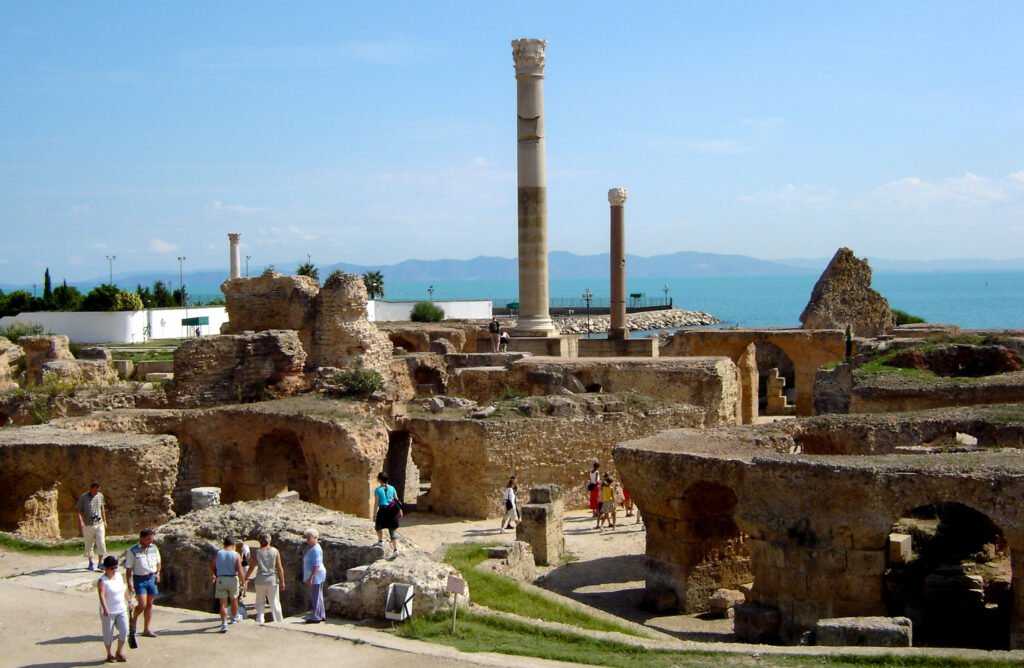
Nothing speaks to the grandeur of Roman Carthage more than the Antonine Baths. Built in the 2nd century CE, this was one of the largest bath complexes in the entire Roman Empire. Perched on the coast with a commanding view of the sea, it was a staggering work of architecture and engineering.
Today, what remains are mostly the sprawling basement and foundation levels. While the grand halls and pools are gone, this subterranean world is fascinating in its own right. It reveals the complex hypocaust system—an underfloor heating network of arches and pillars that circulated hot air to warm the rooms and pools above. Walking through these substructures, you can appreciate the immense scale and logistical complexity required to operate such a facility. In its heyday, this was far more than a place to get clean. It was a massive social center, complete with hot and cold pools (caldarium and frigidarium), gymnasiums for exercise, libraries for study, and gardens for leisurely strolls.
Other Roman Footprints: The Amphitheater and Villas
The baths were just one piece of the Roman city. Elsewhere, the ruins of a massive amphitheater still stand. Capable of seating 30,000 spectators, it hosted gladiatorial games and public spectacles. It was also a significant site in early Christian history, as the location where saints Perpetua and Felicity were martyred in 203 CE.
The wealth of Roman Carthage is also evident in the remains of its luxurious private homes. Excavations of Roman villas across the area have unearthed stunningly preserved mosaics. These intricate artworks depict vibrant scenes from mythology, the natural world, and daily life, offering a colorful window into the prosperous lives of the city’s Roman elite.
Walking Through History: A Modern Visitor’s Itinerary
Having explored the two lives of Carthage, how can a modern visitor experience this layered history firsthand? It’s not about visiting a single, walled-off site, but about embarking on a treasure hunt through a living city. Let’s map out a journey through the ruins.
Navigating the Ruins in a Modern Suburb
First, some practical advice. The archaeological sites of Carthage are not consolidated in one park; they are scattered throughout the modern suburb. The easiest way to get there is by taking the TGM light rail from downtown Tunis to one of the Carthage stations, like “Carthage Hannibal.” Once there, it’s best to purchase a multi-site ticket, which provides access to all the main archaeological areas for a single price. Be prepared to do some walking or take short taxi rides between the sites.
A Suggested Route to Connect the Dots
To make sense of the layers, a logical itinerary helps connect the Punic and Roman stories.
- Stop 1: The Punic Ports & Tophet. Start where the Punic empire began. Stand on the edge of the circular and rectangular lagoons and imagine them filled with warships and merchant vessels. A short walk away is the Tophet, a quiet, contemplative space that hints at the city’s deepest spiritual mysteries.
- Stop 2: Byrsa Hill & Carthage National Museum. Next, ascend Byrsa Hill. Here, you can physically see the Roman forum built over the destroyed Punic city. The Carthage National Museum, located on the hill, is essential for context, housing incredible artifacts from both periods, including Punic pottery and magnificent Roman mosaics.
- Stop 3: The Antonine Baths. End your tour with the most visually stunning Roman ruin. Walk through the colossal foundations of the Antonine Baths to truly appreciate the scale of Roman ambition and engineering.
Capturing the Big Picture
For a final perspective, take a short taxi ride to the nearby cliffside village of Sidi Bou Said. From its famous blue-and-white streets, you can get a panoramic view of the Gulf of Tunis. This vantage point helps you understand the strategic geography that made Carthage so powerful in the first place. As you explore, keep an eye out as you walk the residential streets of Carthage. You might spot an ancient column supporting a modern balcony or a stone block with a Latin inscription built into a garden wall: literal, living reminders of the city’s deep and layered past.
Conclusion
We’ve seen how Carthage is a city with a dual identity, a place of both violent erasure and monumental rebirth. A visit here is a unique archaeological experience. It’s less about seeing a perfectly preserved city like Pompeii and more about becoming a historical detective, piecing together a complex and dramatic story from fragments scattered across a living, breathing community. The silent stones of the Punic ports and the colossal foundations of the Roman baths offer a powerful lesson in the rise and fall of empires. They remind us that history, even when buried, continues to shape the world we live in today.
Further Readings & Resources
For further information, check out the following sources and links:
- UNESCO World Heritage Site Description: Archaeological Site of Carthage: https://whc.unesco.org/en/list/37/
- World History Encyclopedia Entry: Carthage: https://www.worldhistory.org/carthage/
- Carthage National Museum: https://www.patrimoinedetunisie.com.tn/en/museums/the-carthage-museum/overview/
You may also like
Leave a Reply