Step through the heavy, revolving wooden doors and the noise of modern Vienna instantly fades. It’s replaced by a gentle, civilized symphony: the delicate clinking of silver spoons against porcelain, the quiet rustle of a newspaper page turning, the low, intellectual hum of conversation. The air itself feels different here, thick with the rich aroma of roasted coffee and warm Apfelstrudel, layered with the faint, sweet scent of old wood and worn velvet.
This is the Viennese coffee house, an institution that is not merely a café but the city’s public living room, a place that has shaped art, politics, and philosophy for centuries. These establishments are so integral to the nation’s identity that they are protected as a UNESCO Intangible Cultural Heritage, a recognition that the magic here is about much more than what’s in the cup.
In this article, we’ll step through the revolving doors of these storied establishments to uncover their dramatic history, decode their unique culture, and learn the unwritten rules of the Viennese coffee house.
From Battlefield Beans to Intellectual Havens: The History of the Viennese Coffee House
To truly appreciate the enduring magic of these places, we have to travel back to a moment of conflict that, unexpectedly, gave Vienna its most beloved ritual. The story of Viennese coffee is a tale of ingenuity, cultural exchange, and the transformation of a simple beverage into a cornerstone of civic life.
The Legend of the First Cup
The year is 1683, and Vienna is under siege. The vast army of the Ottoman Empire surrounds the city, its fate hanging in the balance. When the siege is finally broken and the invaders are forced into a hasty retreat, they leave behind their tents, their weapons, and, curiously, hundreds of sacks filled with small, dark, mysterious beans. The Viennese, unfamiliar with the strange beans, initially mistake them for camel feed and prepare to burn them.
According to the city’s favorite legend, a Polish officer and spy named Jerzy Franciszek Kulczycki saved the day. Having spent time in Ottoman territory, he recognized the beans as coffee. As a reward for his heroic service during the siege, he was granted the captured sacks. With this bounty, he reportedly opened Vienna’s first coffee house, the “Hof zur Blauen Flasche” (House under the Blue Bottle).
The original Turkish coffee was strong and bitter, an acquired taste for the Viennese palate. Kulczycki, a natural entrepreneur, experimented. He filtered the coffee, softened its flavor with a generous helping of milk, and added a spoonful of honey or sugar. In doing so, he not only made the drink palatable but created the prototype for the beloved Viennese coffee specialties that would follow.
The Evolution into an Institution
While the tale of Kulczycki may be more folklore than fact, coffee houses began to proliferate across Vienna in the following decades. Initially, they were simple, often dark and smoky rooms where men gathered to drink, smoke, and play games. But over the 18th and 19th centuries, they underwent a profound transformation. They blossomed into grand, elegant establishments that became central to Viennese public life.
Crucially, the coffee house became a uniquely democratic space. Unlike the rigid, class-bound salons of the aristocracy, here a university professor could sit near a clerk, and a journalist could debate with a budding politician. The price of a single cup of coffee bought a patron entry into this stimulating world for an entire afternoon.
This accessibility was amplified by a simple yet revolutionary piece of furniture: the `Zeitungsständer`, or newspaper rack. Laden with local and international publications, these racks turned every coffee house into an information hub. For the cost of a `Melange`, a citizen could catch up on world events, read the latest political commentary, and peruse literary journals, making the coffee house a vital engine of public discourse long before the age of mass media.
The Golden Age: A Cradle of Modernism
By the turn of the 20th century—the `fin de siècle`—Vienna was a global capital of art, music, and science, and the coffee house was its beating heart. This was their golden age, a period when these establishments served as the unofficial headquarters for the intellectual and artistic avant-garde who would define modernism. They were more than just meeting places; they were an extension of the home and office for a generation of thinkers living in cramped city apartments.
At Café Griensteidl, and later Café Central, the literary group “Jung-Wien” (Young Vienna) gathered, with writers like Arthur Schnitzler and Hugo von Hofmannsthal dissecting society and the human psyche. When Café Griensteidl was demolished, its patrons simply moved across the street to the palatial Café Central, a breathtaking space with soaring, vaulted ceilings and gothic-style pillars. It was here that a veritable who’s who of 20th-century history could be found.
On any given day, Peter Altenberg, the café’s resident poet, held court while Leon Trotsky played chess, meticulously planning a revolution from his marble-topped table. Architects like Adolf Loos railed against ornamentation, and artists Gustav Klimt and Egon Schiele sketched ideas that would shock the art world. For these figures, the coffee house was a sanctuary—a place to write, think, debate, and find community.
The Anatomy of a Viennese Coffee House
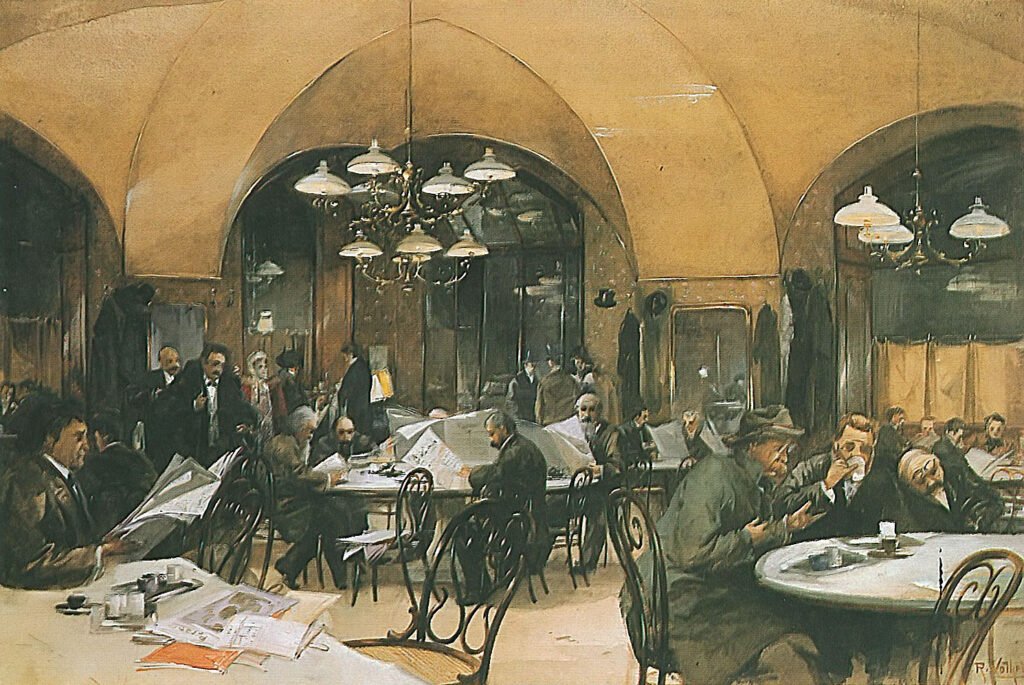
The great minds who frequented these halls weren’t just drawn by the intellectual company but were embraced by an environment meticulously crafted for thought, leisure, and conversation. The design, the service, and the rituals of the coffee house all work in concert to create an atmosphere that is entirely unique.
The “Architecture of Leisure”
The classic Viennese coffee house is a masterpiece of what could be called the “architecture of leisure.” Every design element is intended to make you feel comfortable, unhurried, and inspired. The ceilings are high and often ornately decorated, giving your thoughts room to breathe and expand. Light pours in through massive windows, illuminating the room and connecting the patrons to the city outside.
The furnishings are iconic. You’ll find plush banquettes upholstered in deep red velvet or worn leather, inviting you to sink in and stay a while. The tables are small and topped with heavy, cool marble—perfect for resting a coffee cup, a notebook, or your elbows as you lean into a conversation. And then there are the chairs: most famously, the classic No. 14 chair by Michael Thonet. Made of steam-bent wood, these chairs are lightweight, elegant, and surprisingly comfortable, a perfect blend of form and function. At places like Café Sperl, with its original 19th-century decor, billiard tables, and intimate booths, or the grand Café Central, you can feel how this intentional design fosters a sense of timeless elegance and profound comfort. It’s an environment that tells you, implicitly, to slow down.
An Intangible Cultural Heritage
In 2011, UNESCO officially recognized Viennese coffee house culture as an Intangible Cultural Heritage. This designation is crucial because it clarifies that the heritage is not in the brick-and-mortar buildings themselves, but in the social practices and rituals they contain. UNESCO’s description perfectly captures its essence, defining the coffee house as a place “where time and space are consumed, but only the coffee is found on the bill.”
A key component of this living culture is the waiter, or “Herr Ober” (Mr. Head Waiter). These formally dressed figures, often in black tuxedos, are a world away from the bubbly baristas of modern coffee shops. Their service is famously reserved, a blend of formal politeness that can sometimes be mistaken for gruffness. But this demeanor is part of a long tradition of professional, non-intrusive service. The Herr Ober will take your order, deliver it impeccably, and then leave you in peace for hours if you wish. They are the silent guardians of the coffee house’s tranquil atmosphere.
More Than Just Coffee
The rituals of the coffee house extend beyond the service. When you order a coffee, it will almost always arrive on a small silver tray, accompanied by a small glass of cold, still water. This simple glass of water is a powerful symbol. It is a gesture of hospitality, a silent assurance that you are a welcome guest, not just a customer. It signifies that your presence is valued and that you are invited to stay, read, think, or dream for as long as you like. Your water glass will often be refilled without you even having to ask.
And of course, there is the pastry. A visit to a Viennese coffee house is incomplete without indulging in a slice of cake from the `Kuchenvitrine` (cake display case). From the classic Apfelstrudel, served warm with vanilla sauce, to the rich, decadent Sachertorte, these sweet creations are an integral part of the experience. The coffee house is a place for many activities beyond eating and drinking. It is a haven for reading, with its wide selection of newspapers clipped onto wooden holders. It is a place for quiet contemplation, for playing a long game of chess, or for simply sitting back and watching the elegant theater of Viennese life unfold.
A Modern Visitor’s Guide to an Old-World Tradition
Now that we’ve explored the history and soul of the Viennese coffee house, how does one experience this tradition authentically today? Let’s look at the unwritten rules and essential vocabulary that will help you navigate this cherished world like a local.
The Unwritten Rules: A Guide to Etiquette
The most important rule is to embrace `Verweilkultur`—the culture of lingering. In a world that prizes speed and efficiency, the coffee house is a rebellion. It is not only acceptable but fully expected that you might occupy a table for hours with just a single order. The staff will not rush you or give you pointed looks. This is your time and your space.
When you arrive, it’s customary to wait at the entrance to be seated by the Herr Ober. Once at your table, take your time perusing the menu. When you’re ready to order, make eye contact with your waiter. The service is professional and efficient, not overly chatty. When it’s time to leave, you signal to the waiter that you wish to pay (“Zahlen, bitte”). They will bring the bill to your table, and you pay them directly. A tip of about 10%, rounded up to a convenient number, is customary for good service.
Decoding the Coffee Menu
Ordering coffee in Vienna can seem daunting at first, but a few key terms will unlock the menu. Forget asking for a “cappuccino” or a “latte”; using the local terminology is part of the experience.
- Melange: This is the quintessential Viennese coffee, the closest equivalent to a cappuccino. It consists of a shot of espresso with steamed milk, topped with a cap of milk foam.
- Einspänner: A dramatic and delicious choice, served in a glass. It’s a double espresso topped with a generous mountain of whipped cream (`Schlagobers`). The cream is traditionally not stirred in but sipped through.
- Kleiner Brauner / Großer Brauner: A “small brown” or “large brown.” This is a single or double shot of espresso served with a small pitcher of cream or milk on the side, allowing you to add as much as you like.
- Verlängerter: Literally an “extended” coffee. It’s a shot of espresso diluted with hot water, similar to an Americano.
The Enduring Legacy in the 21st Century
In today’s Vienna, the traditional coffee houses stand proudly alongside modern, third-wave coffee shops. They serve entirely different purposes. One is for a quick, expertly crafted caffeine fix, the other for an escape from the very idea of speed. The enduring appeal of the classic coffee house lies in its role as a sanctuary from the relentless pace and digital distractions of modern life. It’s a place where conversation is valued over connectivity, and where the simple act of sitting still is a cherished pastime. It is not a museum or a relic but a living, breathing, and essential part of the city’s soul.
Conclusion
From a sack of beans left on a 17th-century battlefield to a UNESCO-protected cultural practice, the Viennese coffee house is a testament to the power of place. It has served as a second home for revolutionaries, artists, and thinkers, proving that a simple cup of coffee can fuel not just a person, but an entire culture of innovation and intellectual ferment. These institutions are more than just places to drink coffee; they are archives of history, cradles of creativity, and sanctuaries for the mind. It’s a reminder that sometimes, the most revolutionary act is to simply sit, sip, and think. Isn’t that an idea worth preserving?
Further Readings & Resources
For further information, check out the following sources and links:
- City of Vienna Page: https://www.wien.gv.at/en/leisure/viennese-coffee-culture
- Official Vienna Tourism Guide to Coffeehouses: https://www.wien.info/en/shopping-wining-dining/coffeehouses
- “The World of Yesterday” by Stefan Zweig: An autobiography that provides a rich, first-hand account of Viennese intellectual life at the turn of the century, with many scenes set in coffee houses.
You may also like
Leave a Reply