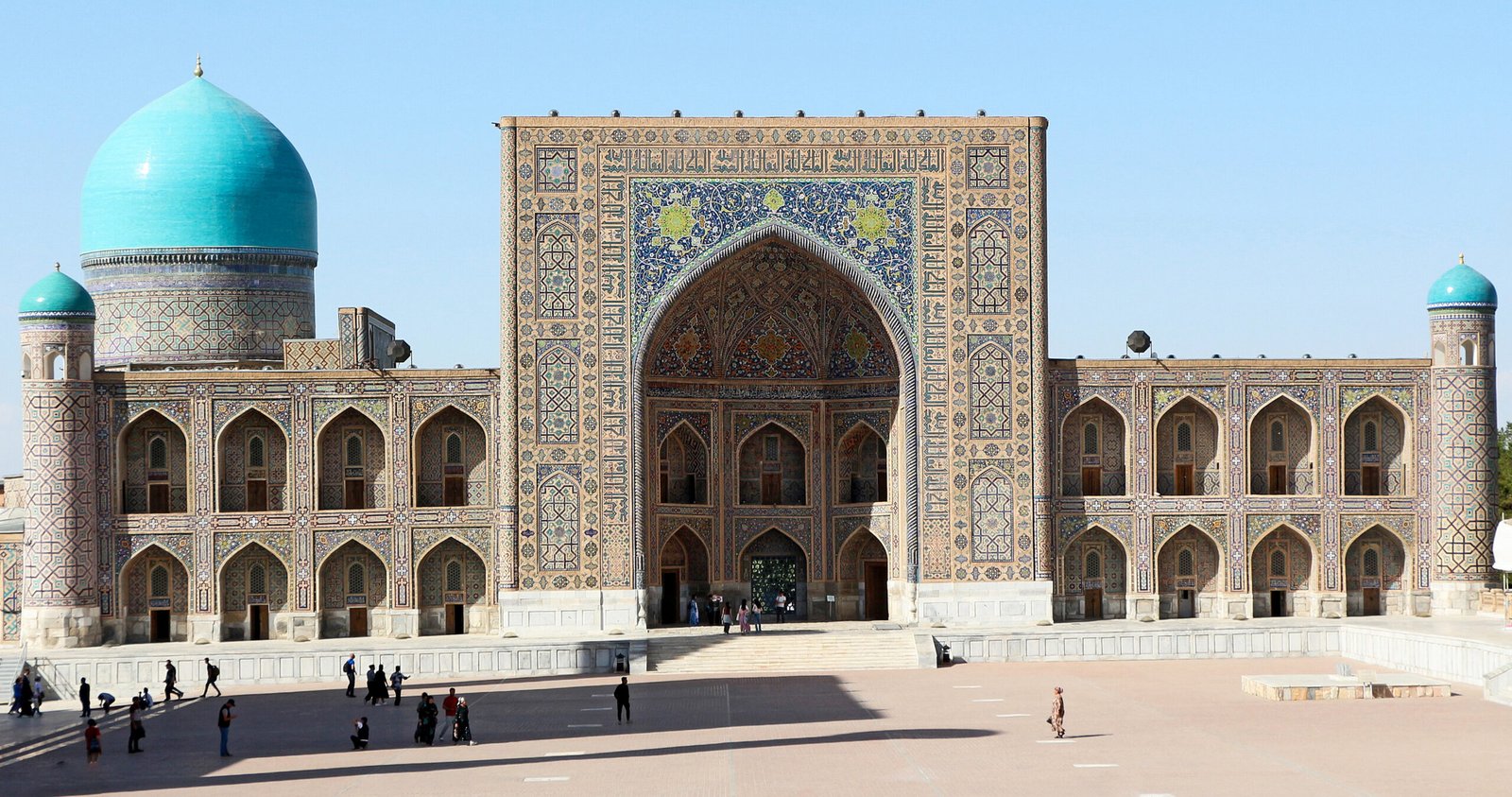
The name itself feels like an incantation, whispered across deserts and centuries: Samarkand. It conjures images of caravans laden with silk and spices, of turquoise domes shimmering under a relentless sun, and of a place at the very edge of the map where the world’s cultures collided.
Samarkand is not just a city in modern-day Uzbekistan but a pivotal jewel on the ancient Silk Road. At its core lies the Registan, a public square so breathtaking in its scale and artistry that it stands as the ultimate symbol of the city’s immense power, faith, and knowledge.
In this article, we’ll journey through the city’s monumental past, walk the hallowed grounds of its architectural masterpieces, breathe in the life of its ancient markets, and explore how the legend of Samarkand has captivated the world for centuries.
The Glistening Oasis on the Silk Road
Before we can truly appreciate the wonders of Samarkand, we need to understand where it is and why its location was destined for greatness. The city thrived because of its strategic position at the crossroads of geography, trade, and ambition that would shape the course of empires.
Pinpointing a Legendary City
If you look for Samarkand on a map today, you’ll find it in the heart of Uzbekistan, nestled in the fertile Zerafshan River valley. This location is the key to its entire history. The valley is a lush, green oasis, a welcome sanctuary in a region defined by the stark Kyzylkum and Karakum deserts to the north and south and the towering Pamir Mountains to the east.
For the ancient caravans trekking the perilous Silk Road, this oasis was a lifeline. It was a natural, essential stopping point for merchants, soldiers, and pilgrims to rest, resupply, and trade before tackling the next leg of their journey between the empires of China and the Mediterranean. This geography—a verdant, watered haven protected by natural barriers—made Samarkand both a priceless prize for conquerors and a thriving haven for the traders who were the lifeblood of the ancient world.
A Crossroads of Empires
With a history stretching back nearly 3,000 years, Samarkand has been coveted by the world’s greatest empire-builders. Known to the ancient Greeks as Marakanda, it fell to Alexander the Great in 329 B.C., who famously declared, “Everything I have heard about the beauty of Marakanda is true, except that it is more beautiful than I could have imagined.” Its strategic position ensured it would never stay in one empire’s hands for long.
Over the centuries, it became a true melting pot. Persian culture laid its administrative and linguistic foundations. Turkic tribes swept in from the steppes, bringing their nomadic traditions. Merchants from India introduced new philosophies and goods, while paper-making (according to legend learned from Chinese prisoners of war in the 8th century) turned Samarkand into a major center for Islamic scholarship.
Before the arrival of Islam, the city was a tapestry of faiths, where Zoroastrian fire temples stood near Buddhist stupas and Nestorian Christian churches. This was a place where ideas were exchanged as freely as goods. It was here that technologies, artistic styles, scientific knowledge, and religious beliefs mingled, creating a unique and sophisticated urban culture that was far more than the sum of its parts.
The Rise of Timur’s Glimmering Capital
In the 14th century, a formidable and ruthless conqueror of Turco-Mongol heritage emerged from the region: Timur, known in the West as Tamerlane. After carving out a vast empire stretching from India to Turkey, Timur declared Samarkand its capital. He was driven by a singular, all-consuming ambition: to make his capital the most magnificent city on Earth, a glittering center of the universe that would awe visitors and immortalize his reign.
To achieve this, Timur employed a brilliant and brutal strategy. As his armies conquered great cities like Damascus, Delhi, and Isfahan, he spared the most talented artisans, architects, scientists, and scholars. He then forcibly marched them back to Samarkand. This influx of genius from across the known world ignited an explosion of creativity. Persian architects worked alongside Indian masons and Azerbaijani tile-makers, all collaborating to build monumental mosques, mausoleums, and madrasas.
This period, known as the Timurid Renaissance, transformed Samarkand from a prosperous trading post into an architectural wonderland and the undisputed epicenter of art, culture, and science in Central Asia.
The Registan: A Symphony in Azure and Gold
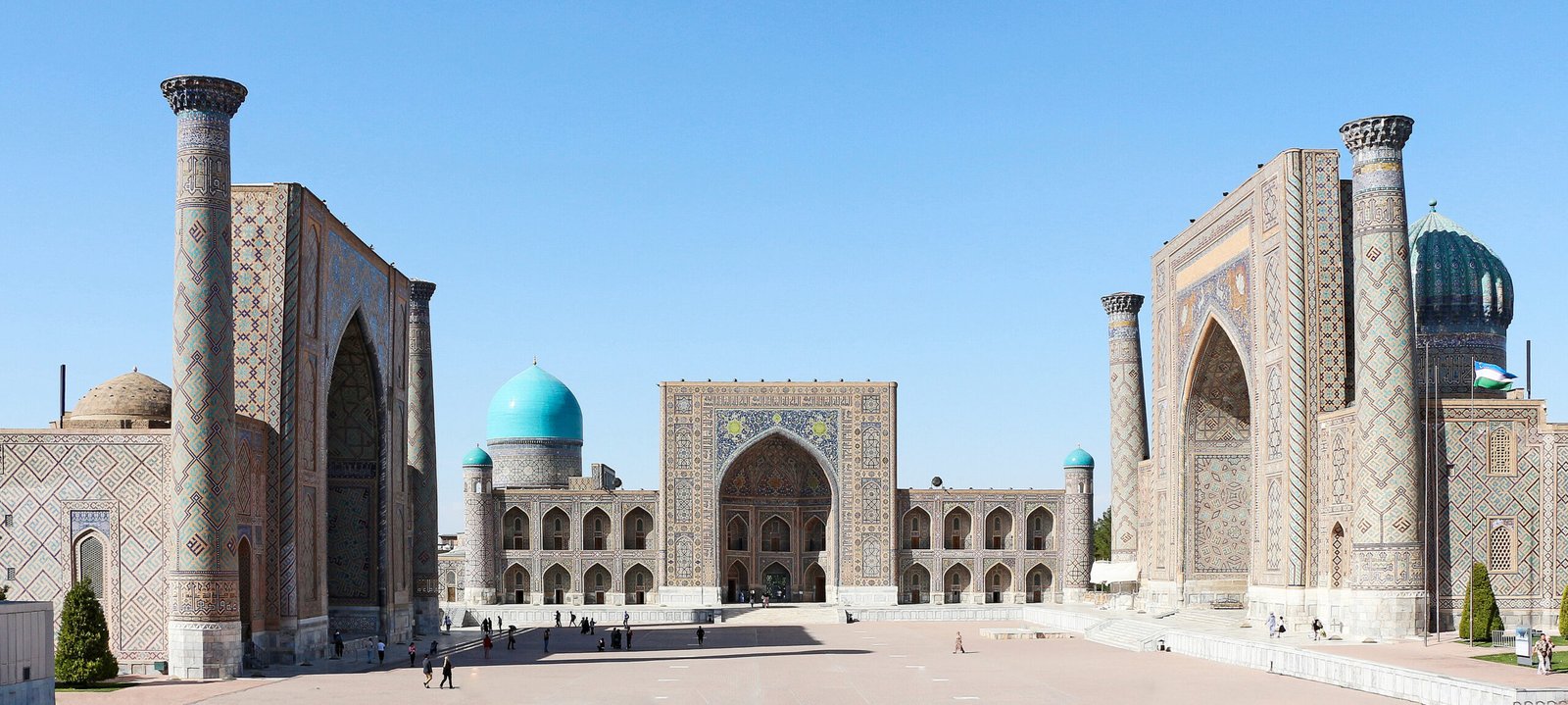
The grandest expression of Timur’s vision, and the enduring symbol of Samarkand, is the magnificent Registan Square. To stand in its presence is to be humbled by the sheer scale of human ambition and artistry. This is not just a collection of beautiful buildings but a perfectly composed architectural ensemble, designed to project power and piety in equal measure.
The Three Madrasas: An Architectural Masterpiece
The name “Registan” translates from Persian as “Sandy Place,” a humble name for what was the public and commercial heart of Timurid Samarkand. Here, citizens gathered to hear royal decrees, watch military parades, and witness public executions. Framing this vast square on three sides are three of the world’s most stunning madrasas (Islamic schools), each a masterpiece in its own right.
To the west stands the Ulugh Beg Madrasa, the oldest of the trio, completed in 1420. It was commissioned by Timur’s grandson, Ulugh Beg, a sultan who was more interested in the stars than the sword. An accomplished astronomer and mathematician, he transformed this madrasa into one of the medieval Islamic world’s finest universities. Its grand portal is decorated with geometric patterns and astronomical motifs, a tribute to its founder’s passions.
Directly opposite, as if in a mirror, is the Sher-Dor Madrasa (“Lion-Bearing”), built two centuries later in the 17th century. Its builders were tasked with replicating the scale and majesty of Ulugh Beg’s creation. They succeeded, but with a daring artistic flourish. Above the main arch are two mosaics depicting roaring, sun-faced creatures that resemble tigers or lions, chasing two deer. This figurative representation was a bold and controversial move in Islamic architecture, which typically forbids the depiction of living beings.
Closing the square to the north is the Tilya-Kori Madrasa (“Gilded”), completed shortly after Sher-Dor. It served a dual purpose as both a residential college for students and, crucially, as the city’s grand mosque. While its exterior is magnificent, its interior is what leaves visitors speechless. The main prayer hall’s dome is not a dome at all but a masterfully flat ceiling, decorated with an overwhelming amount of gold leaf and swirling blue patterns to create a dazzling illusion of depth and celestial grandeur.
Decoding the Tilework: Symbolism and Craftsmanship
What truly defines the Registan is its breathtaking skin of ceramic tiles. The artists used a palette dominated by brilliant blues—lapis lazuli, cobalt, and turquoise—colors that were meant to evoke the heavens and protect the sacred buildings from the desert’s evil eye. These were applied using sophisticated techniques like mosaic faience, where individual pieces of colored tile were cut and fitted together like a jigsaw puzzle, and majolica, where colors were painted onto a single tile before firing.
The designs are a complex visual language. You’ll see intricate geometric patterns known as girih, which represent the underlying order and unity of the universe in Islamic theology. These are interwoven with delicate floral and vine motifs, symbolizing paradise. The most sacred decoration is the calligraphy. Master calligraphers used elegant Kufic and Thuluth scripts to render verses from the Quran in enormous, building-sized panels, turning the madrasas into monumental expressions of faith.
More Than a Square: A Center of Learning and Commerce
The Registan was far more than an architectural showcase. It was the vibrant, functioning core of the city. The square itself was a stage for the empire, but inside the madrasas, a different kind of power was being cultivated: knowledge. For centuries, these were elite institutions of higher learning. Students from across the Islamic world flocked here to study theology, law, Arabic literature, and the sciences. Under Ulugh Beg’s patronage, the study of astronomy and mathematics reached new heights, making Samarkand a beacon of intellectualism whose influence was felt far beyond its walls. The square was where the city’s heart beat loudest, a place where imperial power, divine faith, and human intellect converged.
Echoes of the Bazaar: Samarkand’s Living Markets
While the Registan represents the formal soul of Samarkand, the city’s beating heart has always been its bazaars. The same energy of exchange that defined the ancient Silk Road lives on today in the controlled chaos and sensory overload of its bustling markets.
The Siab Bazaar: A Feast for the Senses
Just a short walk from the grandeur of the Bibi-Khanym Mosque (one of Timur’s most ambitious projects) lies the Siab Bazaar, the city’s largest and oldest market. To step inside is to be immersed in a world of vibrant color, sound, and smell. The air is thick with the warm, yeasty aroma of freshly baked non, Samarkand’s famous round bread, which is piled high on carts, each loaf stamped with a unique, intricate pattern.
Vendors call out, beckoning you to sample their wares from towering pyramids of glistening dried apricots, raisins, walnuts, and pistachios. You’ll find stalls dedicated entirely to spices, their colorful mounds of cumin, turmeric, and paprika creating an aromatic haze. Local farmers sell succulent melons, pomegranates, and mounds of fresh cheese. Deeper inside, you can find artisans selling traditional clothing, hand-carved wooden boxes, and sweet, flaky halva. It’s a place that engages every sense, a living museum of Central Asian culinary culture.
From Silk to Spices: The Enduring Legacy of Trade
The Siab Bazaar is a direct descendant of the caravan-serais and trading posts that made Samarkand rich. While the primary goods are no longer silk from China and jewels from India, the fundamental spirit of the Silk Road persists. This is still a place of connection and commerce, where farmers from the surrounding valleys meet city dwellers, and traditions are passed down through generations.
More than just a place to shop, the bazaar remains a vital social hub. It’s where friends catch up over a cup of green tea, where families do their weekly shopping, and where the daily news is exchanged with the same energy as currency. In the lively haggling and friendly chatter of the Siab Bazaar, the ancient legacy of Samarkand as a great crossroads of the world is still very much alive.
The Myth of Samarkand: From Ancient Legend to Modern Imagination
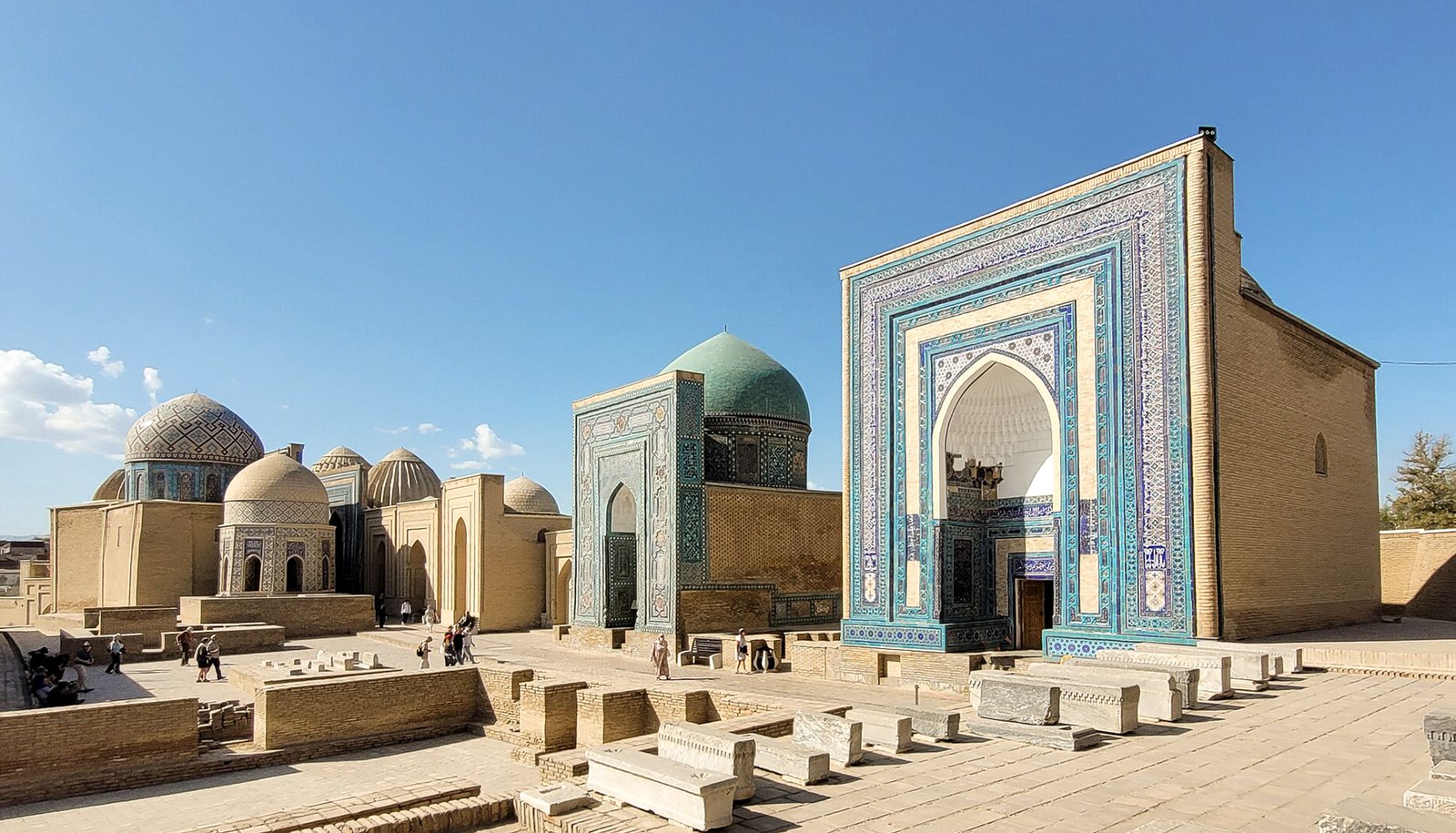
Beyond the stone and tile, Samarkand exists as something more: a powerful idea, a name synonymous with romance, mystery, and the allure of the exotic. For centuries, long before it became an accessible travel destination, its name alone was enough to transport people to a world of fantasy.
“The Golden Journey to Samarkand”: The City in the Western Imagination
For many in the West, the first encounter with the city came not from a history book, but from poetry. In the early 20th century, British poet James Elroy Flecker wrote “The Golden Journey to Samarkand,” a work that cemented the city’s mythical status. In his poem, the journey is more important than the destination, and Samarkand represents the ultimate, dream-like goal at the end of a great adventure. He writes, “For we are marching to Samarkand,” capturing a sense of romantic escapism that resonated deeply.
This idea of Samarkand as a far-flung, almost mythical place was echoed by other writers. Edgar Allan Poe invoked its name to add a touch of the exotic to his tales. More recently, Amin Maalouf’s historical novel Samarkand weaves the story of Omar Khayyam into the fabric of the city’s history. In film and fiction, “Samarkand” became a powerful trope—a shorthand for a distant, magical place where anything was possible.
Separating Myth from Reality
This romanticized image, however, tells only half the story. The golden city of poets was also a city built on conquest and stained with blood. The same Timur who commissioned its most beautiful monuments was also responsible for pyramids of skulls outside the cities he sacked. The wealth that flowed through its markets was the product of a grueling and dangerous trade route, and for every successful merchant, there were countless others who perished in the desert or were lost to bandits.
The historical reality of Samarkand is far more complex and fascinating than the myth. It was a city of brilliant astronomers and ruthless warlords, of pious scholars and enslaved artisans. It was a place of unparalleled beauty but also of incredible hardship. The true magic of Samarkand today lies in this powerful duality. It is both a real, living city with a tangible, complicated history and an enduring symbol in our collective imagination. Visitors walk through streets that are simultaneously part of a modern nation and part of a timeless legend.
Conclusion
From the celestial blues of the Registan to the earthy scents of the Siab Bazaar, Samarkand is a city that engages every sense and fires the imagination. It stands as the ultimate jewel of the Silk Road, a place where the threads of countless cultures were woven together to create something new and extraordinary. The architectural genius of the Timurid era left behind a legacy in stone and tile that still has the power to awe us centuries later.
The city’s endurance comes from its dual identity: as a historical reality, shaped by conquest and commerce, and as a poetic dream, a golden destination in the geography of the mind. Samarkand isn’t just a relic of the past but a vibrant testament to the enduring power of culture, and its golden journey continues today.
Further Readings & Resources
For further information, check out the following sources and links:
- UNESCO World Heritage Centre, Samarkand – Crossroad of Cultures: https://whc.unesco.org/en/list/603/
- The Aga Khan Trust for Culture, Registan Square Conservation: https://the.akdn/en/resources-media/resources/publications/aga-khan-historic-cities-programme-planning-historic-city-samarkand-uzbekistan
You may also like
Leave a Reply