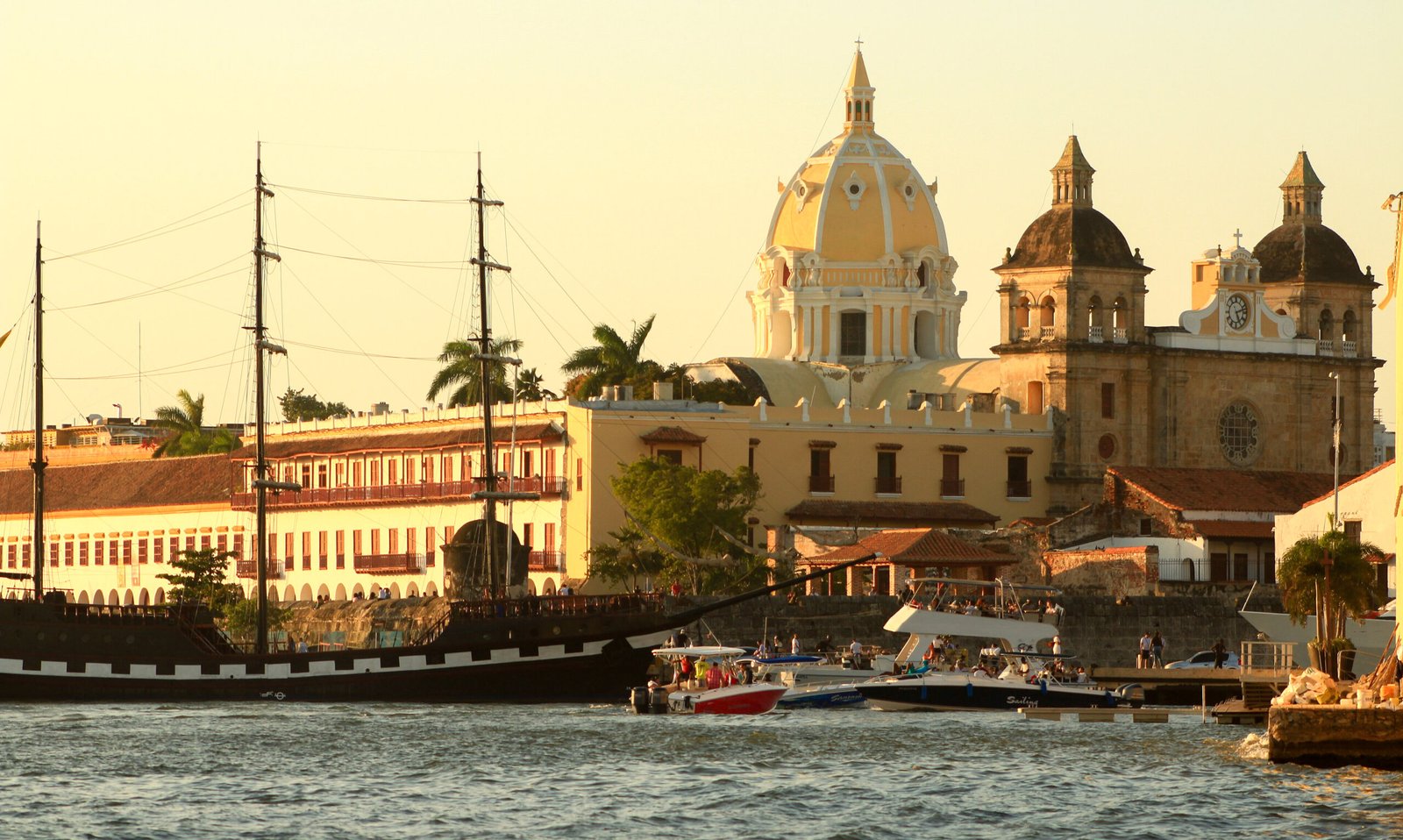
Step onto the sun-drenched coast of Colombia, and you’ll find a city where history isn’t just in museums but in the very foundation you walk upon. Cartagena de Indias is a kaleidoscope of color, where vibrant colonial balconies overflow with bougainvillea, and the turquoise Caribbean Sea laps gently against immense, ancient stone walls.
But this breathtaking beauty was born from a past defined by a powerful paradox: it was a city of unimaginable wealth that lived under the constant, violent threat of being plundered into oblivion. This is the story of how that threat forged Cartagena into the most heavily fortified port in the Americas.
In this guide, we’ll uncover the tales of gold, pirates, and engineering genius etched into the stones of its crown jewel, the Castillo San Felipe de Barajas, and the living fortress of the Walled City.
A Jewel on the Caribbean: The Strategic Birth of Cartagena
Before the first cannon was ever mounted or the first stone of its legendary walls was laid, Cartagena’s destiny was shaped by its geography. To understand the city’s colossal defenses, you first have to understand why this specific spot on the map was so priceless. Founded in 1533 by the Spanish conquistador Pedro de Heredia, the city was blessed with a near-perfect natural harbor. It featured a deep, expansive, and sheltered bay, shielded from the open sea by the island of Tierrabomba and the Barú peninsula. Critically, this bay had only two narrow, defensible entrances: Bocagrande (“Big Mouth”) and Bocachica (“Little Mouth”). Any enemy fleet would have to squeeze through these kill zones to even approach the city.
This prime location made Cartagena the undisputed logistical hub of the Spanish Empire in the New World. It became the main port for the legendary Spanish Treasure Fleet, the convoy system designed to transport the riches of the Americas back to Spain. Imagine the scene: vast quantities of gold plundered from the Inca Empire in Peru, tons of silver mined from the mountains of Bolivia, and chests of priceless emeralds from the Colombian interior would all be funneled into Cartagena’s warehouses. Here, this immense fortune would be stored and guarded for months at a time, awaiting the armed galleons that would escort it across the treacherous, pirate-infested Atlantic. Cartagena was the empire’s bank vault.
The Prize and the Peril: The Age of Pirates and Privateers
Such vast, concentrated treasure, glittering under the Caribbean sun, was an irresistible magnet for Spain’s enemies and the opportunistic vultures of the sea. The city’s early years were plagued by attacks, but it was two specific events that transformed the Spanish mindset from simple defense to total fortification.
The Scourge of the Seas
The raids started almost immediately. In 1544, the French pirate Roberto de Baal sacked the still-fledgling town. He was followed by others, including Martin Cote, each one chipping away at the city’s security and Spain’s coffers. But these early attacks were mere tremors before the earthquake that was to come.
The Dragon’s Fury: Sir Francis Drake’s Assault
In 1586, the most feared privateer of the age set his sights on Cartagena: Sir Francis Drake. Acting with the tacit approval of England’s Queen Elizabeth I, Drake arrived with a fleet of over 20 ships and an overwhelming force of soldiers. The city’s rudimentary defenses—a few wooden forts and a simple chain across the Bocagrande channel—were no match for the English “Dragon.”
Drake’s forces stormed the city, occupying it for over a month. They looted, burned, and desecrated churches, holding Cartagena for a massive ransom that nearly bankrupted the local government. The attack was a profound humiliation for the Spanish Empire. It was a clear and brutal message: the wealth of the New World was not safe. This single event became the catalyst for one of the most ambitious and expensive military engineering projects in history.
The Ultimate Test: The Siege of 1741
Over the next 150 years, the Spanish crown poured resources into transforming Cartagena into a fortress. This investment faced its ultimate test in 1741 during the bizarrely named War of Jenkins’ Ear. A colossal British armada—the largest fleet ever assembled at the time, even larger than the Spanish Armada of 1588—descended upon the city. Commanded by Admiral Edward Vernon, the force consisted of nearly 200 ships and almost 30,000 men, vastly outnumbering the city’s defenders.
Cartagena’s defense was led by one of history’s most tenacious military figures: Admiral Blas de Lezo. A true warrior, he had previously lost his left eye, the use of his right arm, and his left leg in various battles, earning him the nickname “Half-Man.” Facing impossible odds, Lezo masterfully used the city’s now-formidable fortifications to his advantage. The British forces were funneled into the deadly crossfire of the Bocachica forts and then shattered in a disastrous frontal assault against the newly completed Castillo San Felipe de Barajas. Plagued by disease and Lezo’s brilliant defensive tactics, the British invasion collapsed in a humiliating defeat. The fortifications had held. Cartagena had proven itself unbreachable.
An Unbreachable Fortress: Engineering Cartagena’s Defenses
In the wake of Drake’s devastating raid, Spain resolved that Cartagena would never fall again. The result was a masterpiece of military engineering that unfolded over two centuries, turning the entire city into an interlocking system of defense.
The Crown Jewel: Castillo San Felipe de Barajas
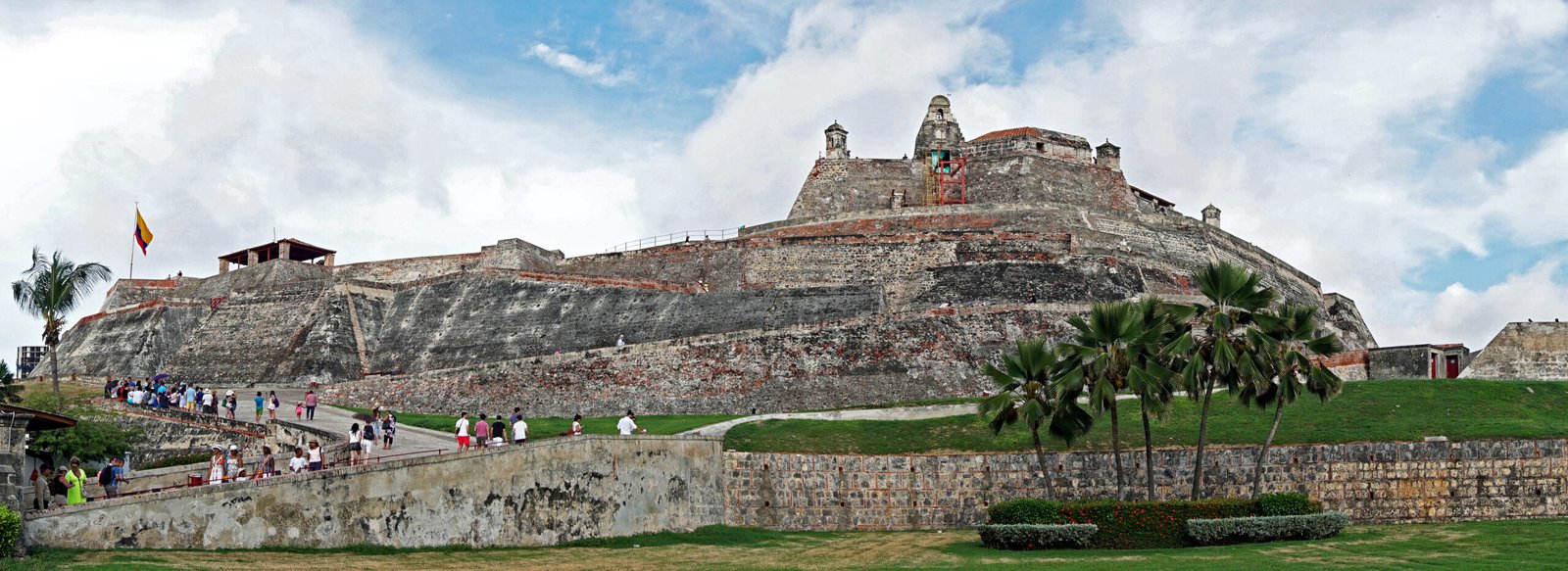
Looming over the city from its strategic perch on the 40-meter-high San Lázaro hill, the Castillo San Felipe de Barajas is the greatest fortress the Spanish ever built in the Americas. It is not a castle in the European sense of a royal residence, but a raw, brutalist work of military genius. Designed to dominate every land and sea approach, its construction is a marvel. Its thick outer walls were built at an angle, creating sloping ramparts designed to deflect or absorb cannonball fire rather than shatter. The fortress is a layered maze of interlocking, self-sufficient gun batteries, each positioned to cover the others, creating overlapping fields of fire that would leave no blind spots for an attacking force.
But its most ingenious feature lies hidden from view. Beneath the stone ramps and parapets lies a complex network of underground tunnels. This subterranean labyrinth was a strategic masterpiece. The tunnels were designed for the rapid and protected movement of troops and supplies between batteries, allowing defenders to reinforce any point under attack without being exposed to enemy fire.
Even more cleverly, the tunnels were an acoustic weapon; their specific design allowed soldiers inside to hear the faint sounds of enemy sappers trying to mine the fortress walls from below. Some sections were even pre-packed with explosives, ready to be detonated to collapse the tunnels on any enemy soldiers who managed to breach them.
The Walled City (Ciudad Amurallada)
While San Felipe was the city’s anchor, the heart of the defense was Las Murallas—the nearly 7 miles (11 kilometers) of stone walls that completely encircle the old town. Built over 200 years from massive blocks of coral stone, these walls are an engineering feat in their own right. They are punctuated by formidable bastions (baluartes), projecting points that allowed defenders to fire along the length of the wall at any attackers trying to scale them, and dotted with iconic, dome-topped sentry posts (garitas).
Walking these walls, you can feel their purpose. They were not just a military barrier but also a powerful tool of social and political control, a definitive line separating the Spanish elite and the wealth of the empire within from the dangers—and the lower classes—of the world outside.
Guarding the Gates: The Maritime Defenses
The entire defensive network was conceived as a “triangular” system. The Walled City was one point of the triangle, the commanding Castillo San Felipe was the second, and the third was the series of forts guarding the Bocachica channel, the main maritime entrance. Here, the forts of San José and San Fernando were built on opposite sides of the narrow channel. This positioning created a deadly gauntlet; any enemy ship that survived the initial cannonade would be subjected to a devastating crossfire. To complete the defense, the Spanish even constructed a massive underwater chain that could be raised between the forts, physically blocking any vessel from entering the bay.
Walking Through History: Your Guide to Exploring Cartagena’s Forts
Today, these incredible fortifications are no longer instruments of war but the vibrant, living heart of Cartagena, a designated UNESCO World Heritage site. They are a playground for history buffs, photographers, and anyone looking to connect with a truly epic past. So, where should you start your exploration?
Conquering the Castillo San Felipe
A visit to Cartagena isn’t complete without climbing the ramps of its greatest fortress. A few practical tips will make your experience better: go early in the morning or late in the afternoon to avoid the punishing midday sun, wear comfortable shoes for the steep climbs, and bring plenty of water. Once there, the real adventure begins. Make sure to descend into the cool, dark, and slightly eerie labyrinth of tunnels to get a sense of what life was like for the soldiers.
The true reward, however, is at the top. From the highest ramparts, you are treated to breathtaking panoramic views of the modern city, the historic Walled City, and the shimmering bay—the very territory this fortress was built to protect. At the base of the hill, don’t miss the powerful statue honoring the city’s savior, the indomitable Blas de Lezo.
A Stroll Atop Las Murallas
One of the most magical experiences in Cartagena is walking along the top of the city walls, especially as the sun begins to set. A great route is to start near the luxurious Charleston Santa Teresa hotel and walk north towards the Baluarte de Santo Domingo. The sea breeze, the sound of the waves, and the sight of the old city’s rooftops turning golden in the fading light is unforgettable.
Inside the Walls: Colonial Squares and History
The fortifications were built to protect the treasures within, and those treasures are still there today in the form of perfectly preserved colonial architecture and bustling public squares. After walking the walls, dive into the city itself:
- Plaza de Bolívar: This is the historic and governmental heart of the old city. Shaded by trees and centered on a statue of the liberator Simón Bolívar, it is surrounded by some of Cartagena’s most important buildings, including the imposing Palace of the Inquisition and the fascinating Cartagena Gold Museum.
- Plaza de Santo Domingo: Arguably the most lively square in the city, it’s famous for its outdoor cafes and restaurants that spill out onto the cobblestones. It’s also home to the “Gertrudis,” a voluptuous reclining woman sculpture by Colombia’s most famous artist, Fernando Botero.
- The Clock Tower (Puerta del Reloj): This iconic yellow clock tower serves as the main gateway into the Walled City. Passing through its arches feels like stepping back in time, leaving the modern world behind and entering a 400-year-old story.
Conclusion
From a treasure-filled port living in constant fear to an impregnable fortress city that defied an empire, the story of Cartagena is written in coral stone. The walls, forts, and tunnels that define the city are far more than just impressive military structures. They are a lasting testament to centuries of conflict, human ingenuity, and the sheer resilience of a city that refused to fall. They tell a story of the vast ambitions of the Spanish Empire, the terror spread by pirates and privateers, and the genius of the engineers and the courage of the soldiers who defended it.
Further Readings & Resources
For further information, check out the following sources and links:
- UNESCO World Heritage Centre Listing for Cartagena: https://whc.unesco.org/en/list/285
- Official Colombia Tourism Site – Cartagena: https://colombia.travel/en/cartagena
- World Monuments Fund – Fortifications of Cartagena: https://www.wmf.org/monuments/san-fernando-and-san-jose-fortresses & https://www.wmf.org/monuments/san-pedro-claver
You may also like

Leave a Reply