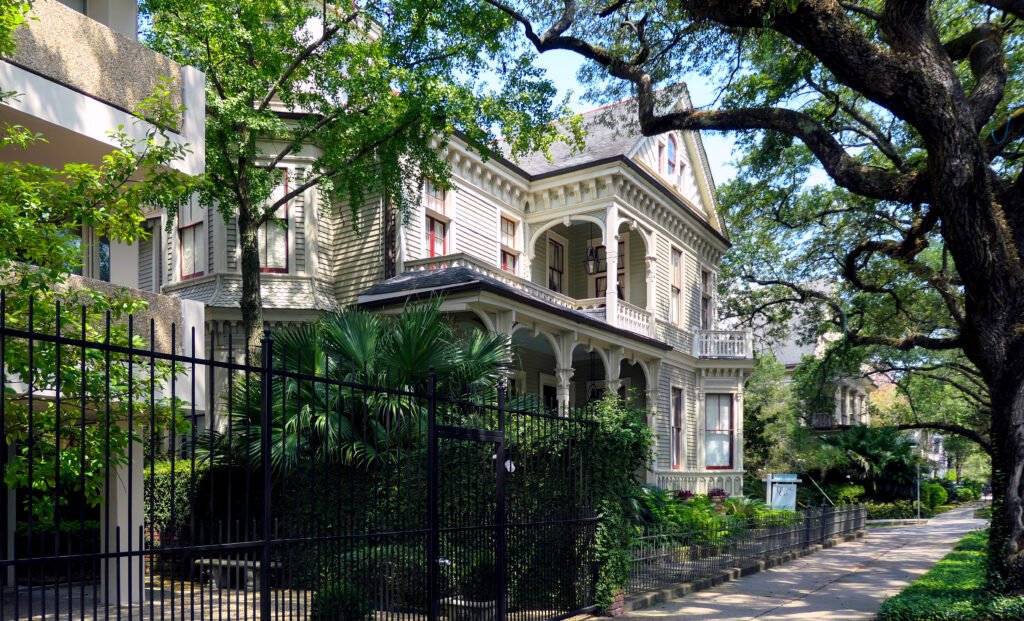
When you leave the sensory overload of the French Quarter and head upriver, the atmosphere shifts. The tight grid of colonial streets gives way to wide avenues, and the noise of Bourbon Street fades into the rhythmic hum of cicadas and the rumble of the St. Charles streetcar. Here, in the New Orleans Garden District, the visual impact is immediate and overwhelming. Ancient live oaks stretch their heavy limbs across the streets to form a cathedral-like canopy that filters the sunlight into dappled patterns on the pavement. Beneath this green ceiling sits a collection of mansions so imposing and ornate that they seem suspended in a different era.
This area is a National Historic Landmark, recognized specifically for its preservation. It represents one of the most intact and impressive collections of historic mansions in the Southern United States. Unlike other historic areas that have lost their residential character to commercialization, the Garden District remains largely as it was intended: a showpiece of domestic architecture.
This article will explore the district’s evolution from a working plantation to an elite suburb, dissect its distinct architectural styles, and highlight the landmarks and legends that define its character today.
The Roots of Grandeur: History, Development, and Architecture
To understand how such a distinct neighborhood came to exist, we must look back to the mid-19th century. The Garden District was not merely a natural expansion of the city. It was a deliberate social and economic statement born from the tensions of a growing metropolis.
From Plantation to the “American Sector”
In 1832, the Livaudais plantation, a large tract of agricultural land upriver from the city center, was subdivided. This event marked the birth of the neighborhood. During this period, New Orleans was culturally divided. The Creoles, descendants of the original French and Spanish settlers, dominated the French Quarter (the Vieux Carré). Following the Louisiana Purchase, wealthy Americans began arriving in the city, but they found the Creole culture insular and the Quarter crowded. These newcomers sought to create a residential enclave that reflected their own tastes and status, separate from the Creoles.
The urban planning of this new “American Sector” differed radically from the European-style density of the French Quarter. The developers designed the area with “garden” plots. While the French Quarter favored “creole cottages” and townhouses built directly up to the sidewalk with hidden interior courtyards, the Garden District inverted this logic. The original lots were massive, often occupying a quarter or half of a city block. This layout mandated a separation between the house and the street. The residence became a centerpiece surrounded by a lush urban landscape of sprawling lawns, azaleas, and magnolias, all framed by decorative wrought-iron fences.
The timing of this development coincided with the antebellum economic boom. Cotton and sugar generated immense wealth in New Orleans during the 1840s and 1850s. This prosperity provided the financial fuel for the construction of the opulent homes that still line these streets. The merchants and factors of the day built these houses not just as homes, but as public displays of their success.
A Tapestry of Styles: Greek Revival to Victorian
Because the neighborhood developed over several decades, the architecture serves as a timeline of 19th-century tastes. You can read the history of the area in the changing columns and rooflines.
Greek Revival
The earliest dominant style in the district is Greek Revival, popular in the 1840s and 1850s. These homes are characterized by their strict symmetry and imposing columns. They typically feature double-galleried facades, meaning they have wide porches on both the first and second floors supported by columns. The style reflected the American democratic ideals of the time, borrowing heavily from classical temple designs.
Italianate
As tastes shifted in the late 1850s and 1860s, the Italianate style began to appear. These homes moved away from the rigid austerity of the Greek Revival. They introduced decorative cornices (the molding at the top of the building), arched windows, and elaborate cast iron work. The focus shifted toward verticality and ornamentation.
Queen Anne & Victorian
By the late 19th century, the industrial revolution and changing aesthetics introduced Queen Anne and Victorian styles. These structures abandoned symmetry in favor of asymmetry. They often feature corner turrets, wrap-around porches, and intricate gingerbread details (wooden scrollwork).
To truly appreciate these structures, it helps to know the specific terms that define New Orleans architecture:
- Gallery: In New Orleans, we rarely say “porch” or “balcony” for these grand outdoor spaces. A “gallery” is a wide, covered outdoor living space, often extending the width of the house.
- Parapet: This is a low wall along the edge of a roof. In the Garden District, parapets were often used to hide the slope of the roof, giving the house a boxier, more substantial appearance from the street.
- Cast-iron lace: This refers to the intricate, repetitive patterns found in the iron fences and gallery railings. While often associated with the French Quarter, the Garden District features exceptional examples where the ironwork incorporates floral or geometric motifs.
Now that we understand the structures themselves, we can turn our attention to the specific sites and the people who inhabit them.
Icons and Residents: Exploring the Neighborhood’s Cultural Fabric
Understanding the architectural theory provides a foundation, but the true experience of the Garden District happens on the sidewalk. A walking tour of the neighborhood reveals how these historical concepts manifest in the physical world today.
Historic Landmarks and Sites
The neighborhood is anchored by several non-residential sites that are integral to its identity.
Lafayette Cemetery No. 1
Located in the heart of the district, this non-denominational cemetery is often called a “city of the dead.” Because the water table in New Orleans is so high, ground burial was historically impossible, leading to the use of above-ground tombs and mausoleums. The cemetery is the final resting place for thousands, including many victims of the yellow fever epidemics that plagued the city in the 19th century. Its crumbling, vine-covered tombs have made it a favorite location for filmmakers.
Commander’s Palace
Directly across from the cemetery stands Commander’s Palace. Recognizable instantly by its turquoise and white Victorian exterior, this is not merely a restaurant. Established in 1893, it has served as a culinary anchor for the neighborhood for over a century. It represents the high-society dining culture that developed alongside the residential wealth of the area.
The Rink
Nearby, a structure known as The Rink offers an excellent example of adaptive reuse. Originally built as a roller skating rink in the late 19th century to entertain the district’s residents, it now serves as a small commercial hub with local shops. It preserves the footprint of the neighborhood’s recreational history while serving a modern purpose.
Famous Residences
Among the private homes, certain properties demand attention. Colonel Short’s Villa is perhaps the most photographed, famous specifically for its fence. The ironwork features a pattern of cornstalks and morning glories. Legend says the Colonel commissioned it for his wife, who missed the cornfields of her native Iowa. Another notable site is the Brevard-Rice House, a greek revival mansion that exemplifies the transition to Italianate detailing.
Legends, Celebrities, and the Modern Scene
The allure of the Garden District has always attracted high-profile residents. This tradition continues today, blending historical prestige with modern celebrity culture.
Famous Residents
Literary and entertainment figures have long found refuge here. The author Anne Rice famously owned several properties in the district, including the Brevard-Rice House mentioned earlier. Her presence and her gothic novels became deeply intertwined with the public perception of the neighborhood. In more recent years, actors like John Goodman and sports figures like Archie Manning have called the district home. These residents tend to blend into the neighborhood fabric, participating in the community rather than walling themselves off.
Privacy vs. Tourism
There is a delicate dynamic between the district as a quiet residential zone and its status as a major tourist destination. The St. Charles Avenue Streetcar, the oldest continuously operating streetcar line in the world, brings a steady stream of visitors from downtown. While this accessibility sustains the local economy, it creates a tension regarding privacy.
Misconceptions
A common misconception among visitors is that the Garden District is a museum or a purely preserved set piece. It is, in fact, a vibrant, occupied community. The people who live here actively maintain the historic integrity of their properties, often at great personal expense. When you see a manicured lawn or a freshly painted gallery, you are seeing the result of current residents stewarding the history, not a government agency maintaining a park.
Conclusion
The New Orleans Garden District offers a unique blend of Southern history, architectural mastery, and sub-tropical landscape. It stands apart from the rest of the city, distinct in its origins and its atmosphere. The true value of the Garden District lies not just in the individual brilliance of a single house, but in the cohesive preservation of a 19th-century “garden city” ideal that continues to thrive in the modern era.
As you leave the district, imagine walking under that canopy of live oaks one last time. It is worth viewing these streets not just as scenery, but as a chapter of history written in wood, brick, and iron.
Further Readings & Resources
For further information, check out the following sources and links:
- New Orleans & Company (Official Tourism Board): A comprehensive guide to the neighborhood’s history, dining, and shopping options. https://www.neworleans.com/plan/neighborhoods/uptown-garden-district/
- Preservation Resource Center of New Orleans: A detailed resource on the district’s development, specific architectural styles, and preservation efforts. https://prcno.org/help-for-homeowners/historic-districts-neighborhoods/garden-district/
- Garden District Association: The official “About” page for the neighborhood association, detailing their mission and community boundaries. https://gardendistrictassociation.com/about/
- Save Our Cemeteries – Lafayette Cemetery No. 1: Detailed information on the history and preservation efforts of the district’s famous cemetery. https://www.saveourcemeteries.org/cemeteries/cemeteries/lafayette-cemetery-no-1.html
- City of New Orleans – HDLC: The official site for the Historic District Landmarks Commission, providing maps and regulatory guidelines for the district. https://nola.gov/next/hdlc/home/
You may also like


Leave a Reply